
Impulscience Program 2026: Lisa Roux and 6 CNRS scientists rewarded
Source: Dossier de presse Fondation Bettencourt Schueller
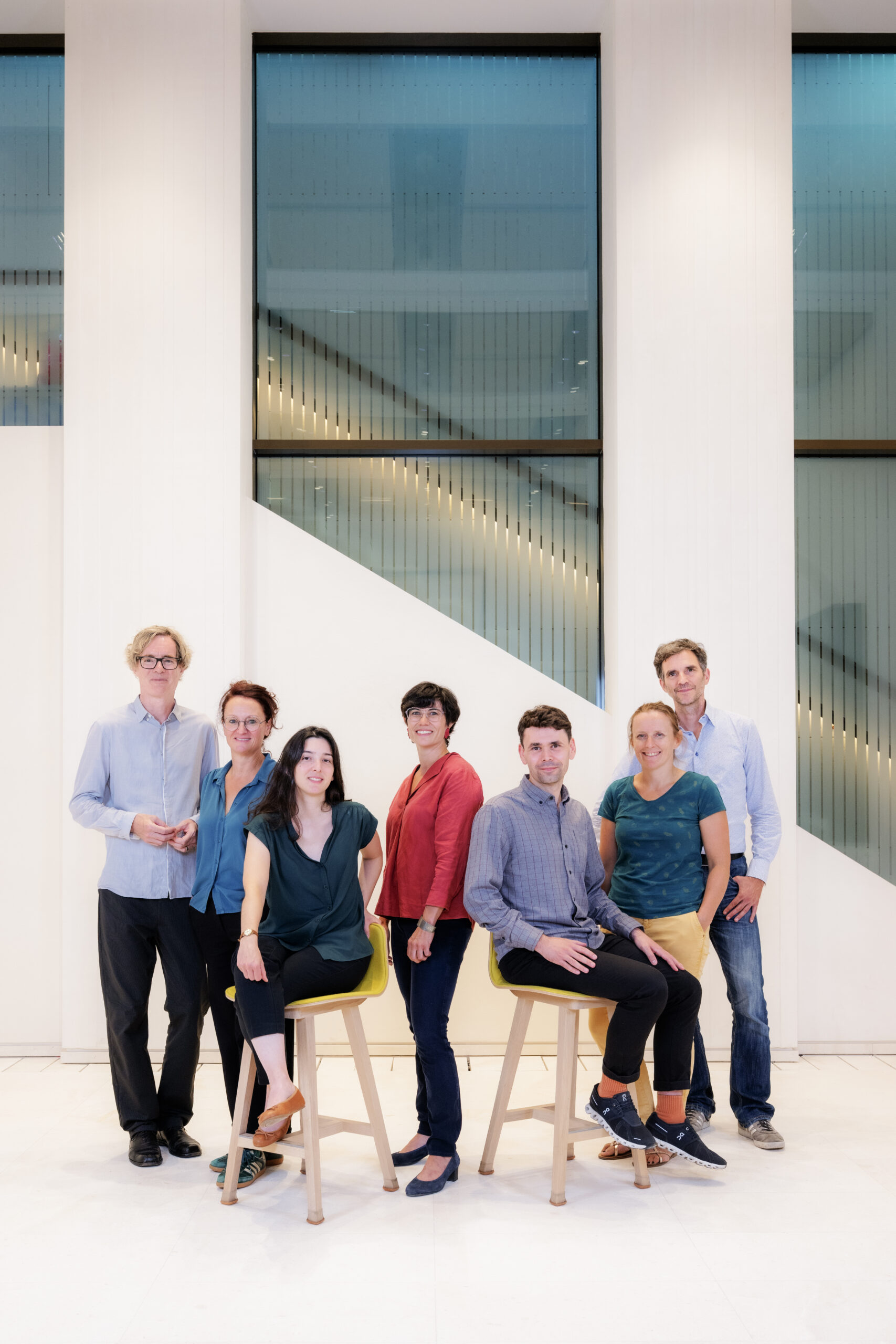
The 7 laureates of the Impulscience program 2026. Lisa Roux (IINS), in the centre. © William Beaucardet / Fondation BS
The Bettencourt Schueller Foundation has unveiled the 2026 laureates of its awards and support programs for life sciences researchers. On November 25, Lisa Roux (IINS) and six other scientists were honored through the Impulscience® program during a ceremony hosted by Françoise Bettencourt Meyers, President of the Foundation, and attended by Hugues de Thé, Chair of the Scientific Council.
How might our breathing contribute to memory problems?
Breathing does more than just supply our bodies with oxygen. Our breath also paces brain activity, acting much like an “orchestra conductor.” With every inhalation and exhalation, neural networks synchronize their activity to the rhythm of our breathing. Beyond this coordinating role, respiration also directly affects the oxygen levels to which neurons are exposed. But in practical terms, how does our breath influence our brain —and, more specifically, our capacity to form memories?
To address this question, Lisa Roux and her team at the Interdisciplinary Institute for Neuroscience (IINS) in Bordeaux are focusing on slow-wave sleep —a phase essential for memory consolidation. During this stage, the brain produces various electrical oscillations, including “ripples” —brief waves generated in the hippocampus, a brain region critical for memory. In slow-wave sleep, these waves help reactivate memories, stabilizing them for long-term retention. Studies using animal models have shown that suppressing these ripples can lead to memory deficits, while prolonging them enhances memory capacity. “One of my team’s goals is to understand how oxygen influences these electrical oscillations in the hippocampus,” explains Lisa Roux, a CNRS research director and laureate of a 2026 Impulscience grant. Her work will also explore the links between sleep apnea and certain cognitive disorders. During an apnea event, airflow decreases or is temporarily interrupted, which can lead to a drop in oxygen levels. “We want to understand how neurons respond to changes in oxygenation and how apnea can trigger micro-arousals,” says Roux. “An excess of micro-arousals disrupts the continuity of sleep and could, therefore, fragment the mechanisms underlying memory consolidation,” she adds.
To understand how respiration creates the optimal conditions for forming lasting memories in mice, the researcher plans to combine several techniques to simultaneously observe the activity of dozens of neurons, respiratory patterns, and fluctuations in oxygen levels. “This project will provide a better understanding of how breathing influences memory and could, in the long term, help prevent certain cognitive disorders linked to respiratory issues,” notes the CNRS research director.
The Impulscience® Program
Created in 2022, the Impulscience program supports seven researchers in the life sciences each year —individuals among the most promising of their generation. Selected for projects that received an excellent evaluation from the European Research Council but went unfunded due to budget constraints, each recipient is awarded €2.3 million over five years, allowing them the freedom to develop their work. Since its inception, the program has recognized 35 laureates and has helped to enhance the appeal of research in France.
More information
Article from CNRS Biologie : https://www.insb.cnrs.fr/fr/cnrsinfo/prix-de-la-fondation-bettencourt-schueller-2026-7-scientifiques-associes-cnrs-biologie
About Lisa Roux : https://www.insb.cnrs.fr/fr/personne/lisa-roux-0